The radicalization of Ethan Harlan
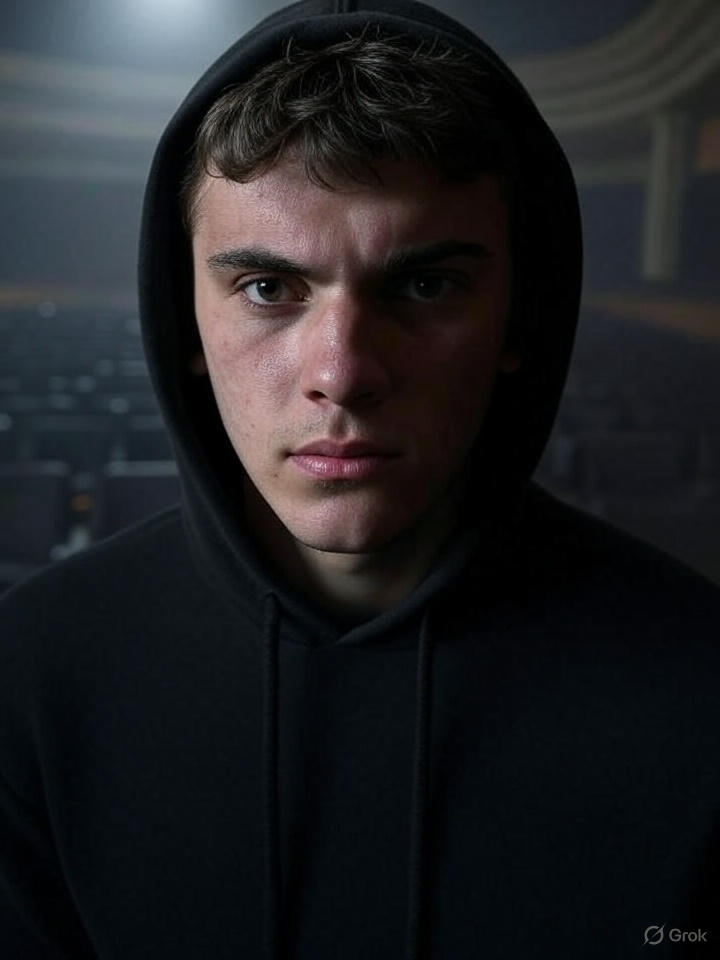
In the heart of rural Kansas, where amber waves of grain stretched endlessly under vast blue skies, lived young Ethan Harlan. Born in 2005 to a family of hardworking farmers, Ethan grew up in a household that embodied "middle America" values—church on Sundays, barbecues with neighbors, and a quiet patriotism displayed through faded American flags fluttering on the weathered porch. His parents, Tom and Linda, were culturally conservative: Tom, a burly man with sun-leathered skin and a perpetual squint from years under the relentless sun, voted Republican out of habit, grumbling about "big government" over dinner while nursing a lukewarm Coors. Linda, softer-spoken with callused hands from tending the garden and mending fences, believed in self-reliance and traditional family roles, often quoting Bible verses about hard work and humility. Their conservatism wasn't deeply rooted in philosophy or education; it was more a product of inertia, passed down like the old John Deere tractor in the barn—functional but never dissected or debated. They didn't read political books or attend rallies; Fox News droned in the background while they balanced the farm's books, with Tom occasionally muttering agreement at the screen. Ethan, their only child, absorbed this passively, echoing his dad's quips about "lazy welfare folks" without much thought, his lanky frame and boyish grin making him a favorite at local 4-H fairs. High school was straightforward: Friday night football games under floodlights, leading the livestock club, and a vague dream of escaping the monotony for college, perhaps to study something practical like agriculture.
When Ethan arrived at Evergreen University—a sprawling liberal arts campus in California—in the fall of 2023, he felt like a fish out of water. His faded Wrangler jeans and Midwestern accent stood out amid the sea of piercings, rainbow flags, and electric scooters zipping across manicured quads. The first building block hit him during freshman orientation, a mandatory three-day program billed as "Building Inclusive Communities." Ethan sat in a packed auditorium, jet-lagged and homesick, clutching a lukewarm coffee, as facilitators—energetic grad students with colorful hair, tattoos, and pronouns in their bios—led sessions on implicit bias, white privilege, and systemic oppression. "We're all complicit in structures of power," one said, projecting slides of historical injustices with dramatic flair. Ethan shifted uncomfortably in his plastic seat; he'd never thought much about race or gender beyond surface-level politeness, like holding doors for folks back home. But the activities were immersive: role-playing scenarios where he had to "check his privilege" as a straight white male from a rural background. Dissent wasn't encouraged; when a kid from Texas questioned a point, the room grew tense, and the facilitator pivoted to "emotional safety" with a practiced smile. By the end, Ethan felt a twinge of guilt he couldn't place—maybe he was part of the problem? The orientation swag bag included a DEI handbook, stickers promoting allyship, and a rainbow lanyard; he tucked it away, resolving to keep his head down and focus on his studies.
As classes ramped up, the second phase enveloped him: curriculum integration. Ethan, majoring in environmental science to "help the family farm go green," found progressive ideas woven into every syllabus like threads in a tapestry. His intro sociology course required readings on critical race theory, framing America's heartland as a bastion of "settler colonialism." The professor, Dr. Elena Ramirez—a tenured activist with sharp features, a Bernie Sanders bumper sticker on her office door, and a penchant for fiery lectures—assigned papers on how "toxic masculinity" perpetuated climate denial, hitting close to home for Ethan, whose dad dismissed global warming as a "hoax" peddled by city elites. In gender studies, a gen-ed requirement, he learned about intersectionality, with lectures portraying conservative values as tools of oppression, delivered by a soft-spoken instructor with wire-rimmed glasses who encouraged "vulnerable sharing" in class discussions. The faculty was overwhelmingly left-leaning; conservative guest speakers were rare, and when one appeared, protests drowned them out with chants and signs. Ethan started parroting the jargon to boost his grades—writing about "decolonizing agriculture" felt foreign at first, but the As rolled in, boosting his confidence. Late-night study sessions with roommates— a diverse crew including a non-binary artist from Seattle and a first-gen immigrant from LA—introduced him to podcasts on equity, chipping away at his unexamined beliefs over shared ramen and energy drinks. He called home less, embarrassed by his parents' "outdated" views, like when his mom asked why he needed to learn about "all that pronoun stuff" in a puzzled tone that made him cringe.
By sophomore year, campus culture and peer pressure solidified the shift. Evergreen's vibe was electric with activism: safe spaces in dorms adorned with posters of historical figures like Angela Davis, trigger warnings on syllabi for topics like colonialism, and a pervasive cancel culture that labeled skeptics as bigots on social media whisper networks. Ethan's new friends—diverse, passionate urbanites like Mia, a fiery Latina organizer with braided hair and a tattoo of a raised fist, and Jax, a queer activist with a quick wit and endless supply of protest signs—invited him to affinity groups for "allies against oppression." At first, he joined out of curiosity, but soon the social rewards hooked him: validation from crushes who praised his "growth" with lingering hugs, invitations to exclusive parties pulsing with indie music and vegan snacks, and a sense of belonging he never felt back home amid the cornfields. Dissenters were ostracized; when a conservative club tried screening a documentary on free speech, protesters blockaded the event, chanting "No platform for hate!" Ethan, now sporting a "Black Lives Matter" pin on his backpack and a beaded bracelet from a solidarity march, distanced himself from his old self, viewing his family's conservatism as ignorant at best, harmful at worst. Social media amplified it—algorithms fed him echo chambers of outrage, from TikToks on microaggressions to X threads decrying "fascist" policies, all consumed in the glow of his laptop during sleepless nights. He blocked his high school buddies who posted pro-Trump memes, feeling liberated yet isolated, the pangs of loneliness dulled by the rush of online likes.
The escalation came junior year, as activism consumed him. What started as attending rallies turned into organizing them, Ethan pounding pavement with flyers and megaphones alongside his tight-knit group. Inspired by campus encampments protesting everything from fossil fuels to foreign policy, he joined a radical collective pushing for "total divestment from oppression," their meetings held in dimly lit basements filled with the scent of incense and urgency. Slogans like "From the river to the sea" echoed in his mind, framed not as calls for destruction but justice by mentors like Professor Ramirez, who dropped by to offer guidance. Professors encouraged "praxis"—action over theory—and Ethan dove in, skipping classes for sit-ins that left him exhilarated and exhausted. The zero-sum worldview took hold: conservatives weren't just wrong; they were enemies enabling genocide, patriarchy, and environmental ruin. Paranoia crept in—masks at protests hid identities, fostering anonymity that emboldened aggression, whispers of "feds" in the crowd making everyone edgy. Ethan cut ties with his family after a heated Thanksgiving call, where his dad's defense of border security sparked Ethan's tirade on "xenophobic imperialism," leaving Tom sputtering in confusion and Linda in tears. He immersed himself in revolutionary texts, dog-eared copies of Fanon and Marcuse stacked on his desk, dreaming of a world remade while staring at the ceiling in his cramped dorm room.
By senior year, the radicalization peaked. Evergreen invited a prominent conservative speaker—a think-tank pundit railing against "woke tyranny"—for a debate on free speech. To Ethan, this was the ultimate betrayal: platforming "hate" under the guise of balance. Whispers in his group chat turned to disruption, then sabotage. Ethan, now a shadow of his former self—sleepless, fueled by rage and isolation, his once-athletic build gaunt from skipped meals and endless vigils—saw the speaker as a symbol of everything wrong: the embodiment of his parents' unexamined conservatism, amplified.
The auditorium hummed with a tense electricity, like the air before a Midwestern thunderstorm—charged, inevitable. It was April 2027, and Evergreen University's grand hall, usually a venue for TED-style talks on sustainability or identity, had been commandeered for what the administration billed as a "dialogue on free speech." But to Ethan Harlan, now 22 and a hollowed-out shell of the farm boy who'd arrived four years earlier, it was a battlefield. The conservative speaker, Dr. Harlan Voss—a silver-haired firebrand from a D.C. think tank, his name eerily echoing Ethan's own surname like some cruel cosmic joke—strode onto the stage to thunderous boos from the back rows. Voss was a symbol: a defender of "colorblind meritocracy," a critic of DEI as "reverse racism," a voice that Ethan had come to see as the root of every systemic evil he'd been awakened to. In his mind, Voss wasn't just wrong; he was the architect of oppression, a white knight for the dying empire of privilege that had crushed voices like those in Ethan's radical circle.
Ethan sat in the shadows of the upper balcony, row Z, seat 14—a vantage point he'd scouted during a feigned janitorial shift two days prior. His hands, callused from childhood hay bales but now trembling with a mix of adrenaline and something deeper, an alienating void, clutched the cold steel of the Glock 19. He'd acquired it through an encrypted app connection in San Francisco's underbelly, justified in feverish group chats as "preemptive justice" against fascism's enablers. The weight of it pressed against his palm, a talisman of significance in a life that had unraveled into insignificance. Back home in Kansas, his parents' farm eked by on subsidies he now decried as corporate welfare; here, in the echo chamber of Evergreen, he'd learned that his unexamined conservatism was complicity in genocide—Palestinian, environmental, existential. Social alienation had seeped in like frostbite during his freshman year, turning homesickness into a profound disconnection, a "need" for belonging that the 3N model of radicalization his sociology prof had lectured on now mirrored back at him in horrifying clarity. He'd felt it then: the narrative of injustice weaving through his veins, the network of masked comrades pulling him deeper into the web where moral justification blurred into dehumanization. Voss, in Ethan's fractured psyche, wasn't human anymore—just a vector for harm, a threat to the equity he'd sacrificed everything for.
His heart hammered, a staccato rhythm syncing with the muffled chants from the floor below: "No platform for hate!" Voss adjusted his microphone, his voice booming with that folksy drawl Ethan once might have admired. "Ladies and gentlemen, the true tyranny isn't in ideas—it's in silencing them. This woke cult…" The words ignited something primal. Ethan's breath shallowed, the world narrowing to a tunnel: the speaker's profile against the spotlight, the glint of his cufflinks like shackles on the oppressed. Sweat beaded on Ethan's forehead, mixing with the residue of last night's Red Bull and unresolved rage. In that suspended instant, flashes assaulted him—orientation workshops where he'd first confessed his "privilege" in tearful circles, feeling seen for the first time; late-night affinity group huddles where friends' affirmations drowned out the ghost of his father's disappointed silence; the moral disengagement that let him scroll past beheading videos with detached nods, convinced violence was the only dialectic left. Trauma from a fractured family, amplified by campus isolation, had cracked him open; now, the ideology poured in like venom, promising purpose through pain.
He rose slowly, the seat creaking like a warning he ignored. The gun felt alive in his grip, its grip textured against his skin—a false anchor in the storm of uncertainty that radicalization thrives on, turning personal voids into collective fury. No one noticed him amid the sea of protesters; he was just another face in the crowd, anonymous in his black hoodie, the mask from last semester's encampment dangling from his pocket like a talisman. Voss paused mid-sentence, gesturing emphatically: "…erodes the very foundations of our republic!" Ethan's finger hovered over the trigger, a precipice. In literature's shadowed annals, assassins often linger here—Oswald in DeLillo's Libra, frozen in the book depository's vertigo, or the IRA plotters in Jonathan Lee's High Dive, hearts pounding with the weight of history's rewrite. But Ethan wasn't a character; he was real in his delusion, questing for significance in a spray of bullets, the radical's ultimate bid to etch meaning into chaos.
Time fractured. He raised the Glock—two-handed stance cribbed from a YouTube tutorial on "defensive praxis"—and squeezed. The first shot cracked like thunder over the plains, echoing off the vaulted ceiling. Voss jerked, a crimson bloom unfurling on his starched white shirt as he crumpled against the podium, microphone screeching feedback into the pandemonium. Screams erupted, a tidal wave crashing through the hall; bodies surged toward exits in blind panic, while Ethan's comrades below—his network—froze in stunned solidarity before the frenzy took them. A second pull, instinctive, sent another round whispering through the air, grazing the stage lights in a shower of sparks. Ethan's mind blanked to white noise, the recoil jolting up his arms like judgment day. No regret, only a fleeting righteousness: This is for the silenced, the displaced, the earth itself. But beneath it, the alienation roared back—hadn't the model warned of this? The narrative's grip tightening into a noose, propelling the isolated youth toward the act that seals his isolation forever.
Security swarmed the balcony as Ethan lowered the gun, spent casings tinkling to the carpet like fallen ideals. Hands pinned him down, zip ties biting into wrists that had once baled hay under endless skies. In the melee below, Voss lay still, the spotlight pooling blood like spilled ink on a manifesto. Ethan met the eyes of a fleeing student—wide, accusatory—and for a split second, saw his younger self staring back: lost, unformed, radicalized into ruin. The auditorium lights flickered, plunging the scene into strobe-lit hell, as sirens wailed in the distance—a dirge for the boy from middle America who'd traded amber waves for a hail of lead.
In the aftermath, headlines screamed of a "tragic radicalization," while Ethan's parents, shattered in their Kansas farmhouse—Tom staring blankly at the kitchen table, Linda clutching a photo of young Ethan on a tractor—wondered where their boy had gone wrong. The university issued statements on mental health and dialogue, but the cycle churned on, claiming another soul from the heartland.
by Alfonso Beccar Varela and Grok


Comentarios
Publicar un comentario